Mixed waste processing plant
Mixed waste processing plant
Mixed waste processing plant
About our Mixed waste processing plant
msw biogas plant
Efficient mixed MSW Plant: Turning Waste into Resources
Look, we all know waste is a growing problem. Landfills are filling up, and traditional disposal methods aren’t cutting it anymore. That’s where our mixed waste processing plant comes in. It’s not just a big pile of machinery; it’s a smart, efficient system designed to take your city’s daily trash and turn it into something useful.
Think of it like this: your garbage trucks come in, and instead of just dumping it all into a hole, we sort mixed waste according to its compositions and characteristics then it goes to next step. We pull out the recyclables – the metals, plastics, and paper – and give them a second life. Then, we take the organic stuff, like food scraps and yard waste, and turn it into rich compost, perfect for gardens and farms. And if there’s anything left that can’t be recycled or composted, we can even turn that into RDF which is used in reducing the need for fossil fuels.
Solid waste treatment machines and plants
Dry Waste:
Composition:
- Primarily consists of materials that are not easily degradable and have low moisture content.
- Often found in municipal solid waste (MSW) streams.
- Examples: Paper, cardboard, plastics, glass, metals, textiles, and wood.
Characteristics:
- Generally recyclable.
- Less prone to producing odors or leachate (contaminated liquid).
- Easier to handle and store.
FR Engimech Dry waste Processing:
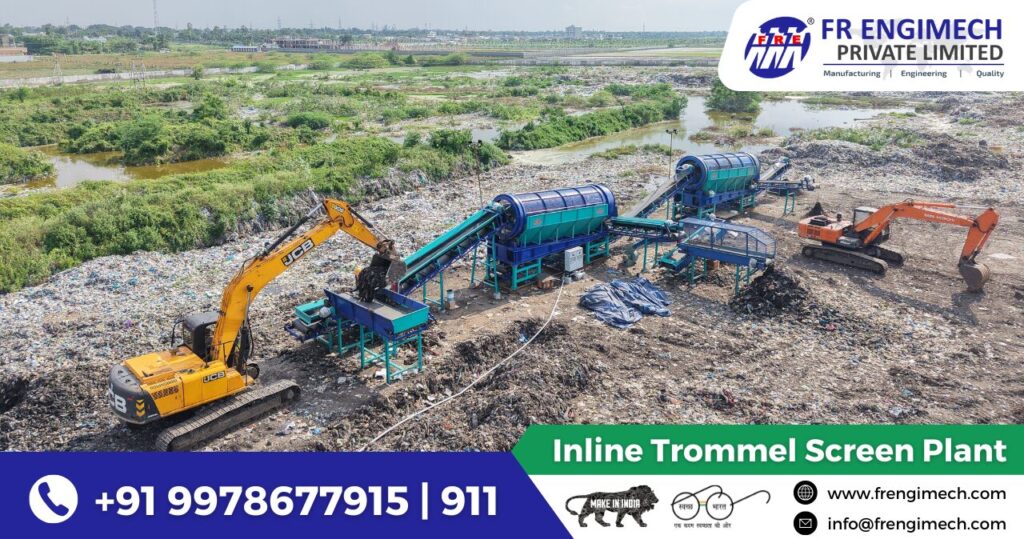
- FR Engimech Dry waste processing plant processed through mechanical separation techniques like sorting, screening, and magnetic separation.
- Our advanced sorting and separation trommel system are used to separate Dry waste components.
- Recyclable materials are recovered, and non-recyclable materials may be used for refuse-derived fuel (RDF).
Wet Waste:
Composition:
- Primarily consists of organic materials with high moisture content
- Often found in municipal solid waste (MSW) streams.
- Examples: Food scraps, vegetable peels, garden waste, and other biodegradable materials.
Characteristics:
- Highly degradable.
- Prone to producing odors and leachate.
- Requires specialized processing to prevent environmental pollution.
FR Engimech Wet waste Processing:
- FR Engimech wet waste processing plant processed through biological methods like composting or anaerobic digestion.
- Our advanced sorting and separation trammel system are used to separate wet waste components.
- Anaerobic digestion produces biogas (renewable energy) and digestate (fertilizer).
Mixed Waste:
Composition:
- A combination of dry and wet waste, along with other miscellaneous materials.
- Often found in municipal solid waste (MSW) streams.
- Can contain hazardous materials, requiring careful handling.
Characteristics:
- Requires a comprehensive processing approach due to its heterogeneous nature.
- Presents challenges for separation and resource recovery.
FR Engimech Mixed waste Processing:
- Involves a combination of mechanical and biological processing techniques.
- Our Advanced sorting and separation trommel systems are used to separate dry and wet waste components.
- Often these streams are then sent to seperate dry and wet waste processing lines.
Key features and benefits
- Advanced Segregation Technologies
- Material recovery facility
- Municipal daily waste solution
- Resource Recovery Systems
- Biomining Capabilities
- Environmental Remediation
- Public Health Improvement
- Reduction of Landfill Hazards
Why choose FR Engimech for mixed waste processing plant?
- We handle all kinds of trash: Dry, wet, mixed – we've got it covered.
- We sort it smartly: Using cool tech like screens and system, we pull out the good stuff for recycling.
- We build it just for you: We know every city is different, so we customize our plants to fit your needs.
- We care about the planet: We're big on recycling, composting, and even making energy from waste.
- We're reliable: We've built lots of these plants, and we know what we're doing.
- We're here to help: We don't just build the plant; we stick around to make sure it runs smoothly.
- Contact us today….
how does it works?
- Municipal solid waste is collected and transported to the segregation plant.
- The waste is typically unloaded into a receiving area or hopper.
- From the hopper, the waste is fed onto a conveyor belt that transports it to the trommel screen.
- A trommel screen is essentially a large, cylindrical drum with perforated screens of varying sizes.
- The drum rotates, causing the waste to tumble inside.
- As the waste tumbles, smaller materials fall through the screen perforations, while larger materials continue to move along the drum.
- Different sections of the trommel have different sized perforations, allowing for multiple size separations.
- Undersized Material: Smaller materials that fall through the screens are collected on conveyors and directed to specific areas for further processing or disposal.
- Fine organic materials for composting.
- Smaller recyclable materials.
- Oversized Material: Larger materials that remain in the drum are discharged at the end. This might include:
- Large pieces of plastic.
- Cardboard.
- Other bulky waste.
After the trommel screen, the separated materials may undergo further processing,
Manual sorting to remove contaminants.
Magnetic separation to remove ferrous metals.
composting of organic materials.
- The separated materials are then directed towards recycling, composting, or landfill disposal.
LOOKING FOR MUNICIPAL SOLID WASTE SOLUTION?
Our 15+ years of experience in the field has given us unparalleled expertise in design
and supply of high quality waste management plants and machinery. This puts us at the forefront of global innovation in this sector. Our client list speaks for itself: hundreds
of customers spread across all indian states and territories. If you’re seeking waste
technology solutions, you need look no further.
We’re here to help.
Contact us today.
Send A Message
"*" indicates required fields